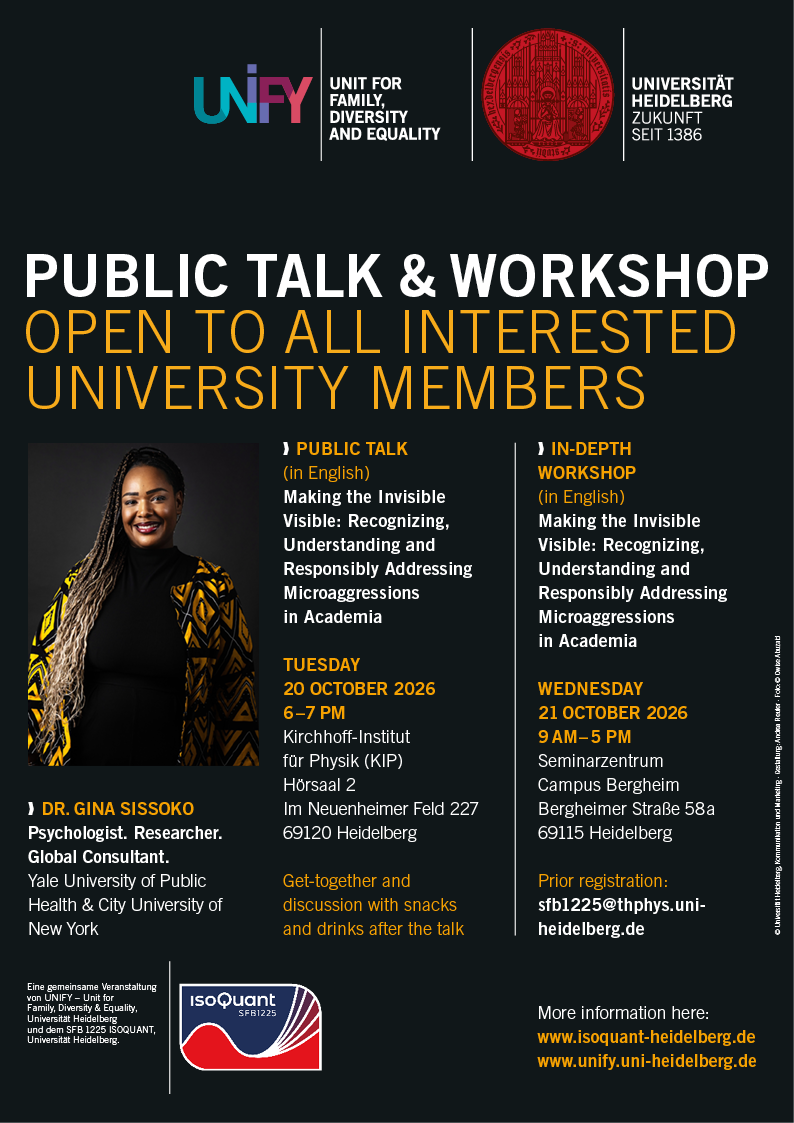
Public Talk
Making the Invisible Visible: Recognizing, Understanding and Responsibly Addressing Microaggressions in Academia
Tuesday, 20 October 2026 | 6–7 PM
Kirchhoff-Institut für Physik (KIP), Hörsaal 2
Im Neuenheimer Feld 227, 69120 Heidelberg
Microaggressions are often subtle. They can take the form of seemingly casual comments, questions, assumptions or behaviours and may sometimes go unnoticed by those who express or witness them. Yet their cumulative effects can significantly shape people’s experiences of belonging, recognition and participation in academic environments.
How can we recognize microaggressions in everyday academic life? What role do hierarchies, power relations and institutional structures play? Why can the reactions that follow a microaggression – including minimization, victim blaming, gaslighting or silence – matter just as much? And, most importantly, how can we respond in ways that are constructive, supportive and sensitive to discrimination?
The CRC 1225 ISOQUANT together with UNIFY – Unit for Family, Diversity & Equality invites all interested university members to explore these questions with clinical psychologist and researcher Dr. Gina Sissoko (Yale School of Public Health & City University of New York).
Her approach combines psychological research with practical strategies for academic environments. Particular attention will be given to the distinction between intention and impact, the role of power and positionality, and concrete microinterventions: ways of listening, responding, supporting others and intervening when microaggressions occur.
The public talk provides an accessible introduction to microaggressions in academic settings. Dr. Sissoko will discuss how microaggressions emerge, how psychological and institutional dynamics shape their impact, and why the reactions of colleagues, supervisors and bystanders can play an important role.
The talk will also introduce practical approaches for responding to microaggressions and contributing to a more inclusive and respectful academic culture.
Afterwards, participants are warmly invited to continue the conversation at an informal get-together with snacks and drinks.
The talk is open to all interested university members. No prior registration is required.