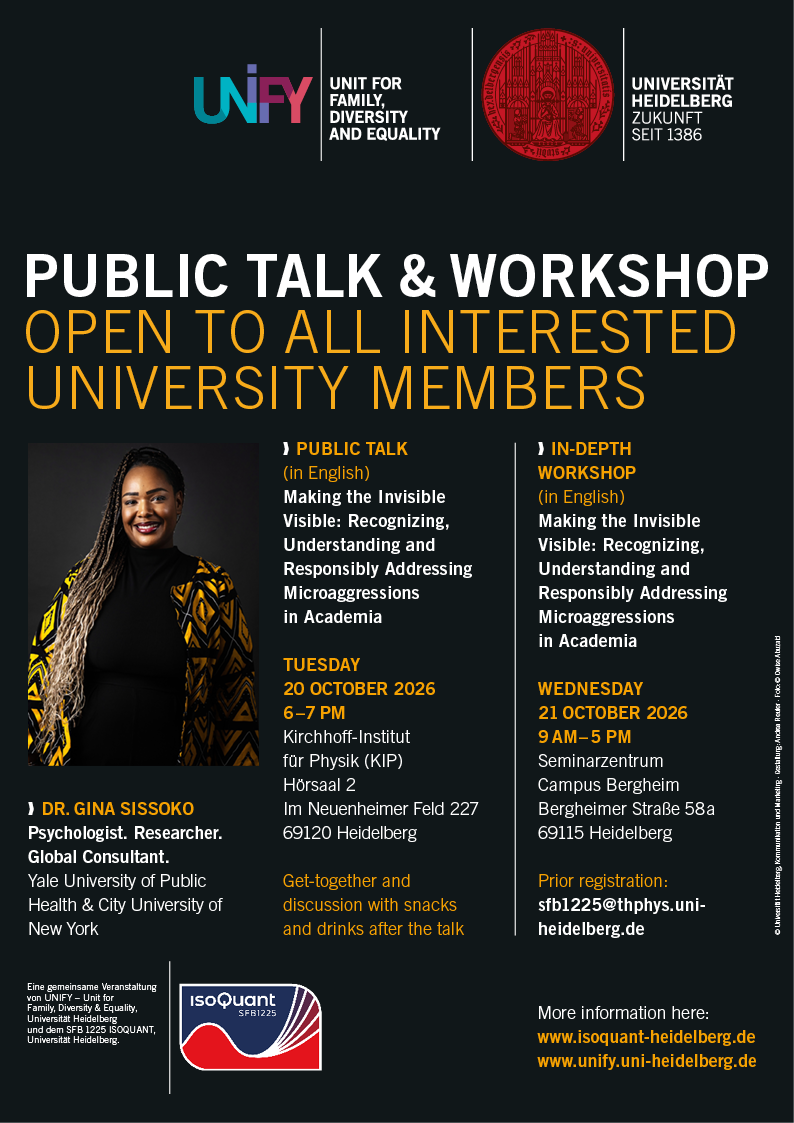
In-Depth Workshop
Making the Invisible Visible: Recognizing, Understanding and Responsibly Addressing Microaggressions in Academia
Wednesday, 21 October 2026 | 9 AM–5 PM
Seminarzentrum Campus Bergheim
Bergheimer Straße 58a, 69115 Heidelberg
Building on the themes of the public talk, the full-day workshop provides space for deeper reflection and practical application.
Using examples from university and research settings, participants will examine how microaggressions arise and why they can be difficult to recognize or address. The workshop considers the perspectives of people directly affected as well as colleagues, bystanders, supervisors and teaching staff. Participants will explore how intention, impact, power and positionality interact and what can make speaking up or intervening difficult. Sissoko Heidelberg Okt 2026 – A…
Through research-based input, case discussions, small-group reflection and practical exercises, participants will develop and practise strategies for responding to microaggressions. The aim is not only to increase awareness, but to translate that awareness into concrete options for action in everyday academic situations.
The workshop is particularly relevant for doctoral researchers, postdocs, academic staff, teaching staff, coordinators, members of DEI/equality teams, supervisors and people in leadership roles.
Places are limited, prior registration is required:
sfb1225@thphys.uni-heidelberg.de
About Dr. Gina Sissoko
Dr. Gina Sissoko is a licensed clinical psychologist, researcher and educator whose work focuses on the intersection of discrimination, psychosocial health and empowerment. She is currently a researcher at the Yale School of Public Health and teaches psychology as an Adjunct Assistant Professor at the City University of New York (CUNY).
Her research and teaching address microaggressions, intersectional discrimination and racialized mental health, with a particular focus on Black people and other multiply marginalized communities. She served for more than six years as a DEI representative at CUNY and co-founded the Diversity Science Initiative, which works toward structural change in research, teaching and early-career development. She has given more than 50 professional talks internationally and published more than 25 academic papers on discrimination, microaggressions and systemic inequality.
Her approach is research-based, reflective and interactive, with a strong emphasis on translating complex concepts into practical strategies that can be applied in academic environments.